
Reproduction in Plants and Animals
 Reproduction Overview
📌 Introduction
Reproduction is a fundamental biological process by which living organisms produce new individuals of their own kind. It ensures the continuity of species and maintains the balance of life on Earth.
Reproduction is broadly classified into two main types:
- Asexual Reproduction: Involves only one parent; no fusion of gametes.
- Sexual Reproduction: Involves two parents (male and female); requires the fusion of gametes.
🌿 Reproduction in Plants
Plants have developed various ways to reproduce, both to spread quickly and to ensure genetic diversity.
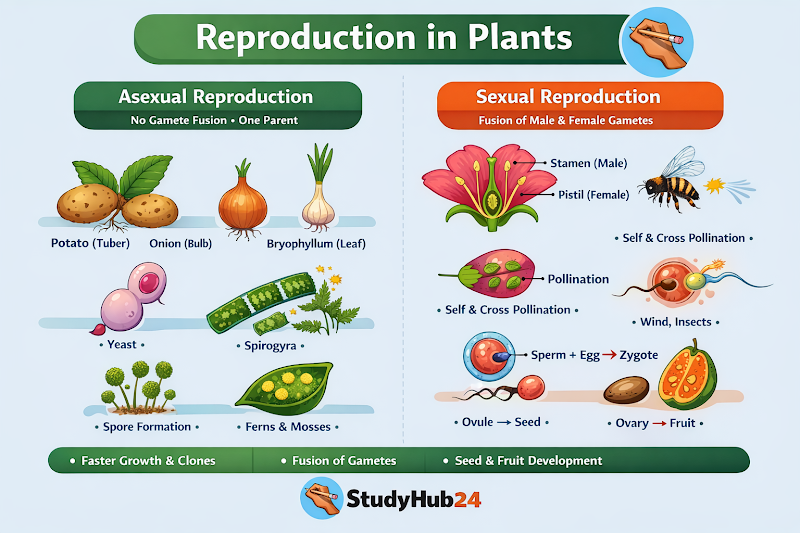
1. Asexual Reproduction in Plants
In asexual reproduction, new plants are produced without the help of seeds.
Types:
- Vegetative Propagation: New plants grow from vegetative parts like roots, stems, or leaves.
- Example: Potatoes (stem tubers), Onions (bulbs), Bryophyllum (leaf buds).
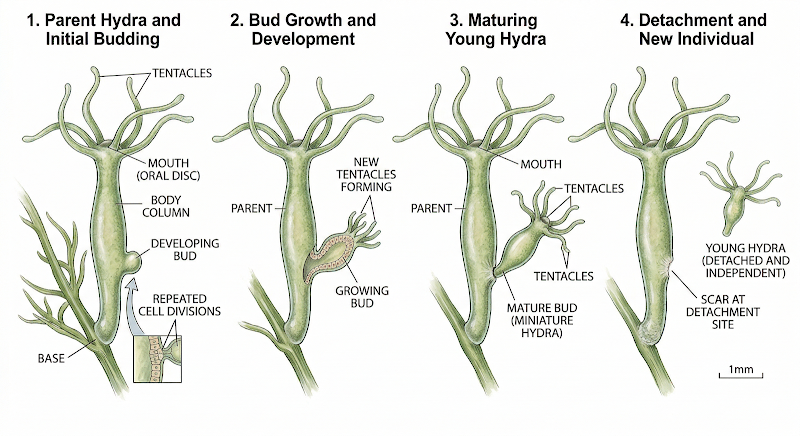
- Budding: a small outgrowth called a "bud" forms on the parent body, matures, and then detaches.
- Example: Yeast.
- Fragmentation: The body of the parent breaks into pieces, and each piece grows into a new individual.
- Example: Algae (Spirogyra).
- Spore Formation: Tiny, specialized cells called spores are released into the air. When they land on a moist surface, they grow into new plants.
- Example: Ferns and Mosses.
 Hydra Budding
2. Sexual Reproduction in Plants
Flowers are the reproductive parts of a plant.
- Stamen (Male Part): Produces pollen grains (male gametes).
- Pistil/Carpel (Female Part): Contains the ovary and ovules (female gametes).
The Process:
- Pollination: The transfer of pollen from the anther (male) to the stigma (female).
- Fertilization: The fusion of the male gamete (from pollen) and the female gamete (in ovule) to form a Zygote.
- Seed Formation: After fertilization, the ovule develops into a seed, and the ovary ripens into a fruit.
🧬 Reproduction in Animals
1. Asexual Reproduction
Found in simpler organisms.
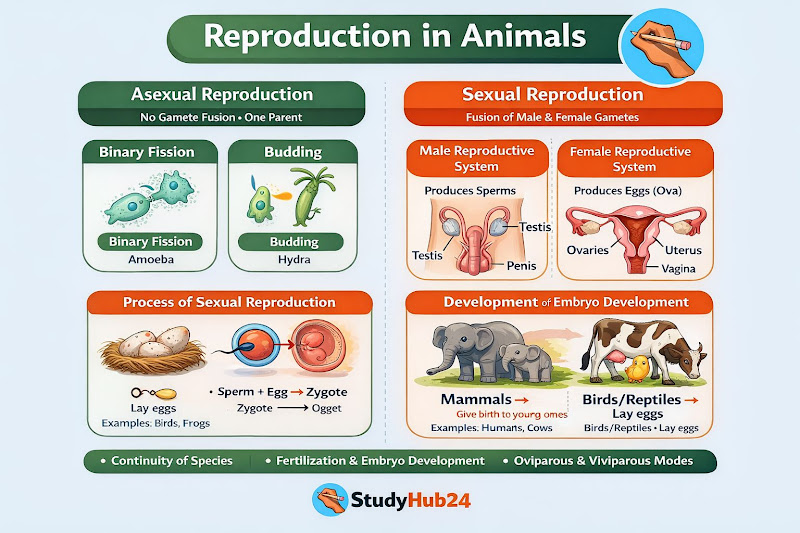
- Binary Fission: A single cell divides into two equal halves. Example: Amoeba.
- Budding: A new individual grows out of the parent's body. Example: Hydra.
2. Sexual Reproduction
Involves the fusion of a Sperm (male gamete) and an Egg/Ovum (female gamete).
The Process of Fertilization:
- Internal Fertilization: Happens inside the female body (e.g., Humans, Cows, Hens).
- External Fertilization: Happens outside the female body, usually in water (e.g., Frogs, Fish).
 Sexual Reproduction
Modes of Development:
- Oviparous: Animals that lay eggs (e.g., Birds, Lizards).
- Viviparous: Animals that give birth to fully developed young ones (e.g., Humans, Dogs).
🔬 Comparison Table
| Feature | Plant Reproduction | Animal Reproduction |
|---|---|---|
| Common Type | Both Sexual & Asexual | Mostly Sexual |
| Organs | Flowers (Stamen/Pistil) | Reproductive Systems |
| Mobility | Fixed parents | Mobile parents |
| Fertilization | Often via pollinators | Internal or External |
🧠 Knowledge Check (MCQs)
Q1: Which of the following reproduces by binary fission?
- a) Hydra
- b) Amoeba ✅
- c) Yeast
- d) Mushroom
Q2: Animals that lay eggs are called:
- a) Viviparous
- b) Oviparous ✅
- c) Mammals
- d) Hermaphrodites
Q3: Which part of the flower contains the ovule?
- a) Anther
- b) Filament
- c) Ovary ✅
- d) Petal
📘 Case Study: Life Cycle of a Frog
Frogs exhibit a fascinating life cycle called Metamorphosis.
- Eggs: Laied in water (External Fertilization).
- Tadpole: Breathes through gills and lives in water like a fish.
- Adult Frog: Develops lungs and legs to live on land.
- Q: Why do frogs lay eggs in water?
👉 Because fertilization is external and requires water for the sperm to reach the eggs. - Q: What is the process of a tadpole becoming a frog called?
👉 Metamorphosis.