
Fundamental Duties
 Fundamental Duties
📌 Introduction
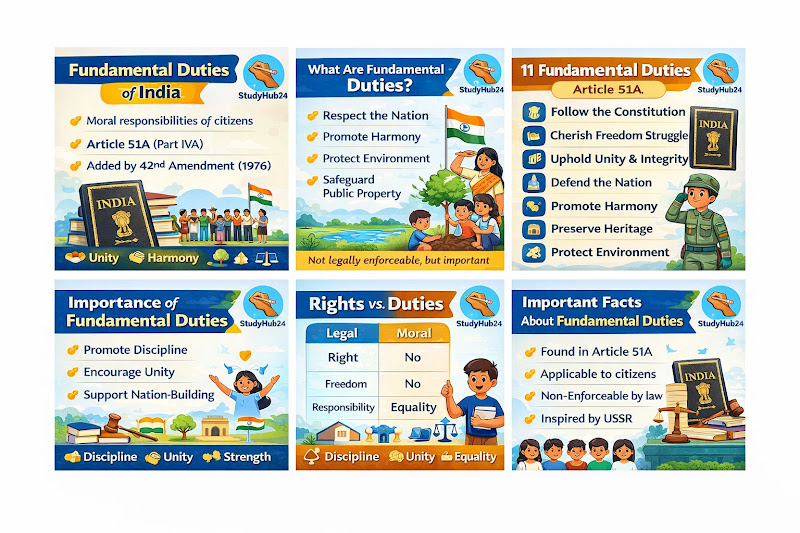
Fundamental Duties are the moral responsibilities of every Indian citizen to help promote unity, discipline, and patriotism in the country. These duties are mentioned in Article 51A (Part IVA) of the Indian Constitution. They were added by the 42nd Amendment Act, 1976, based on the recommendations of the Swaran Singh Committee.
👉 Key Fact: Initially, there were 10 duties. The 11th duty (providing education to children) was added by the 86th Amendment Act, 2002.
📜 What are Fundamental Duties?
Fundamental Duties serve as a reminder to citizens that while they enjoy rights, they also have certain obligations towards the nation. They are intended to:
- Respect the ideals of the nation
- Promote communal harmony
- Protect the environment
- Safeguard public property
💡 Important: Unlike Fundamental Rights, these duties are non-justiciable, meaning they are not legally enforceable by courts, though they are vital for responsible citizenship.
🧾 List of 11 Fundamental Duties
According to Article 51A, every Indian citizen must:
1. Respect the Constitution
- Abide by the Constitution and respect its ideals and institutions.
- Respect the National Flag 🇮🇳 and the National Anthem.
2. Cherish Freedom Struggle Ideals
- Cherish and follow the noble ideals that inspired the national struggle for freedom.
3. Uphold Unity & Integrity
- Protect the sovereignty, unity, and integrity of India.
4. Defend the Country
- Defend the country and render national service when called upon to do so.
5. Promote Harmony
- Promote harmony and the spirit of common brotherhood amongst all the people of India.
- Transcend religious, linguistic, and regional or sectional diversities.
- Renounce practices derogatory to the dignity of women.
6. Preserve Cultural Heritage
- Value and preserve the rich heritage of the country’s composite culture.
7. Protect the Environment 🌱
- Protect and improve the natural environment including forests, lakes, rivers, and wildlife.
- Have compassion for living creatures.
8. Develop Scientific Temper 🔬
- Develop scientific temper, humanism, and the spirit of inquiry and reform.
9. Safeguard Public Property
- Safeguard public property and abjure violence.
10. Strive for Excellence
- Strive towards excellence in all spheres of individual and collective activity.
11. Duty of Parents
- Provide opportunities for education to his child or ward between the age of six and fourteen years.
⚖️ Features & Importance
Features
- Applicable only to citizens: These duties do not apply to foreigners.
- Non-justiciable: No legal sanction for their violation.
- Moral & Civic: Some are moral duties (ideals of freedom struggle) while others are civic duties (respecting flag).
Importance
- They serve as a warning against anti-national and anti-social activities.
- They help the courts in examining and determining the constitutional validity of a law.
- They promote a sense of discipline and commitment among citizens.
⚖️ Fundamental Rights vs. Duties
| Feature | Fundamental Rights | Fundamental Duties |
|---|---|---|
| Nature | Legal / Political | Moral / Civic |
| Enforceable | Yes (Justiciable) | No (Non-justiciable) |
| Focus | Individual Freedom | Social Responsibility |
📘 Practice Questions (Exam Ready)
🔹 Very Short Answer Questions
- Where are Fundamental Duties mentioned?
👉 Article 51A (Part IVA) - When were they added?
👉 1976 (42nd Amendment) - How many Fundamental Duties are there currently?
👉 11
🔹 Short Answer Questions
- Why are Fundamental Duties considered non-justiciable?
👉 Because they cannot be enforced by law or courts; they are moral guidelines for citizens. - What is meant by 'Scientific Temper'?
👉 It refers to logical, rational, and evidence-based thinking instead of superstition.
🧠 Section A: Multiple Choice Questions (MCQs)
Basic Level
Q1: Fundamental Duties are mentioned in which part of the Constitution?
- a) Part II
- b) Part III
- c) Part IVA ✅
- d) Part V
Q2: Which amendment added the Fundamental Duties?
- a) 44th Amendment
- b) 42nd Amendment ✅
- c) 86th Amendment
- d) 73rd Amendment
Q3: In which year were Fundamental Duties added?
- a) 1950
- b) 1976 ✅
- c) 1992
- d) 2002
Q4: What is the total number of Fundamental Duties today?
- a) 10
- b) 11 ✅
- c) 12
- d) 9
Concept Based
Q5: The Fundamental Duties are inspired by the constitution of:
- a) USA
- b) UK
- c) USSR (Russia) ✅
- d) France
Q6: Which duty relates specifically to the environment?
- a) Article 51A(g) ✅
- b) Article 14
- c) Article 19
- d) Article 21
📖 Section B: Case-Based Questions
Case Study: Public Assets
Scenario: Ramesh participates in a protest and deliberately breaks the windows of a public bus.
- Q: Which fundamental duty has Ramesh violated?
👉 The duty to safeguard public property and abjure violence. - Q: Is this action legally punishable?
👉 While the duty itself is non-justiciable, the act of damaging property is a criminal offense under the Prevention of Damage to Public Property Act.
Case Study: Education
Scenario: A parent refuses to send their 10-year-old child to school, claiming it is their personal choice.
- Q: Which duty is being ignored here?
👉 The 11th Fundamental Duty: providing education to children aged 6–14. - Q: Which amendment added this specific duty?
👉 The 86th Constitutional Amendment Act, 2002.
🧪 Summary Table
| Duty Type | Examples |
|---|---|
| Civic Duty | Respecting Flag, Anthem, Constitution |
| Moral Duty | Cherishing Ideals of Independence |
| Social Duty | Promoting Harmony, Protecting Environment |