
The Preamble of the Indian Constitution
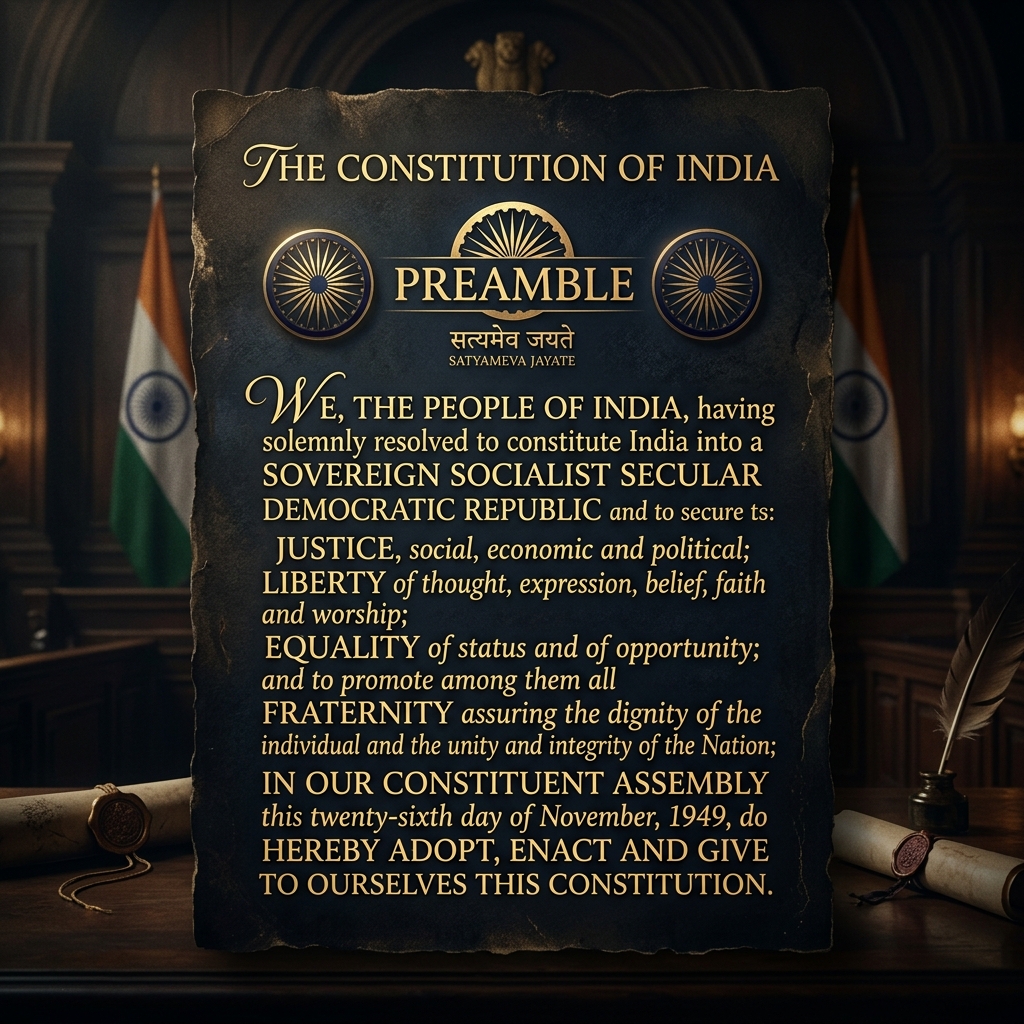 The Preamble
📌 Introduction
The Preamble is the introductory statement of the Indian Constitution that sets out the guidelines, principles, and objectives of the nation. Renowned jurist N.A. Palkhivala called the Preamble the "Identity Card of the Constitution."
It is based on the 'Objectives Resolution', drafted and moved by Pandit Jawaharlal Nehru, and adopted by the Constituent Assembly.
📜 The Text of the Preamble
"WE, THE PEOPLE OF INDIA, having solemnly resolved to constitute India into a SOVEREIGN SOCIALIST SECULAR DEMOCRATIC REPUBLIC and to secure to all its citizens:
JUSTICE, social, economic and political;
LIBERTY of thought, expression, belief, faith and worship;
EQUALITY of status and of opportunity;
and to promote among them all FRATERNITY assuring the dignity of the individual and the unity and integrity of the Nation;
IN OUR CONSTITUENT ASSEMBLY this twenty-sixth day of November, 1949, do HEREBY ADOPT, ENACT AND GIVE TO OURSELVES THIS CONSTITUTION."
🔑 Key Keywords Explained
The Preamble contains several powerful words that define the nature of the Indian State.
1. Sovereign
India is an independent authority. It is not a dominion of any other external power. It is free to conduct its own internal and external affairs.
2. Socialist
Added by the 42nd Amendment (1976). India follows 'Democratic Socialism', which aims to end poverty, ignorance, and inequality of opportunity through a mixed economy.
3. Secular
Also added by the 42nd Amendment. It means all religions in India have the same status and support from the State. India does not have an official state religion.
4. Democratic
The Constitution establishes a form of government that derives its power from the will of the people expressed in elections.
5. Republic
The head of the state (The President) is elected and not a hereditary monarch (like in the UK).
⚖️ Legal Status: Is the Preamble part of the Constitution?
This was a subject of great debate in the Supreme Court:
| Case | Year | Ruling |
|---|---|---|
| Berubari Union Case | 1960 | The Supreme Court said the Preamble is NOT a part of the Constitution. |
| Kesavananda Bharati Case | 1973 | The Court rejected the earlier view and held that the Preamble IS a part of the Constitution. |
| LIC of India Case | 1995 | The Court held that the Preamble is an integral part of the Constitution. |
💡 Important: The Preamble is non-justiciable (not enforceable in a court of law), but it acts as a guiding light for interpreting the Constitution.
🛠️ Can the Preamble be Amended?
Yes, under Article 368, but the "Basic Structure" of the Preamble cannot be destroyed.
- 42nd Amendment Act (1976): This is the only time the Preamble has been amended.
- Three new words were added: Socialist, Secular, and Integrity.
📘 Practice Questions (Exam Ready)
🔹 Section A: MCQs
Q1: Which of the following words was NOT in the original Preamble of 1950?
- a) Sovereign
- b) Democratic
- c) Secular ✅
- d) Republic
Q2: The Preamble was amended by which Constitutional Amendment Act?
- a) 44th
- b) 42nd ✅
- c) 86th
- d) 73rd
Q3: Who described the Preamble as the 'Identity Card of the Constitution'?
- a) B.R. Ambedkar
- b) K.M. Munshi
- c) N.A. Palkhivala ✅
- d) Jawaharlal Nehru
🔹 Section B: Short Answer Questions
- What are the four components of the Preamble? 👉 Source of authority (People), Nature of State, Objectives, and Date of Adoption.
- What is meant by 'Liberty' in the Preamble? 👉 It refers to the absence of restraints on the activities of individuals and providing opportunities for development.
🧪 Summary Table: Objectives vs. Ideals
| Ideals (Nature of State) | Objectives (For Citizens) |
|---|---|
| Sovereign | Justice |
| Socialist | Liberty |
| Secular | Equality |
| Democratic | Fraternity |
| Republic |