
Adaptation in Plants – Types, Examples and Importance
 Hero Image
📌 Introduction
Plants live in different environments such as deserts, mountains, forests, and water bodies. To survive in these habitats, plants develop special features called adaptations. These adaptations help plants save water, obtain sunlight, protect themselves, and grow successfully. Understanding plant adaptations helps students learn how plants survive in extreme conditions.
📜 Key Concepts
Plant adaptation refers to the special features or characteristics that help plants survive in their surroundings.
Key purposes of plant adaptations:
- Save water in dry regions 💧
- Float or survive in water 🌊
- Protect plants from extreme cold or heat 🌡️
- Absorb sunlight efficiently ☀️
- Support healthy growth and reproduction 🌱
🌵 Types of Plant Adaptations
Plants are categorized based on their habitat and the specific adaptations they have developed.
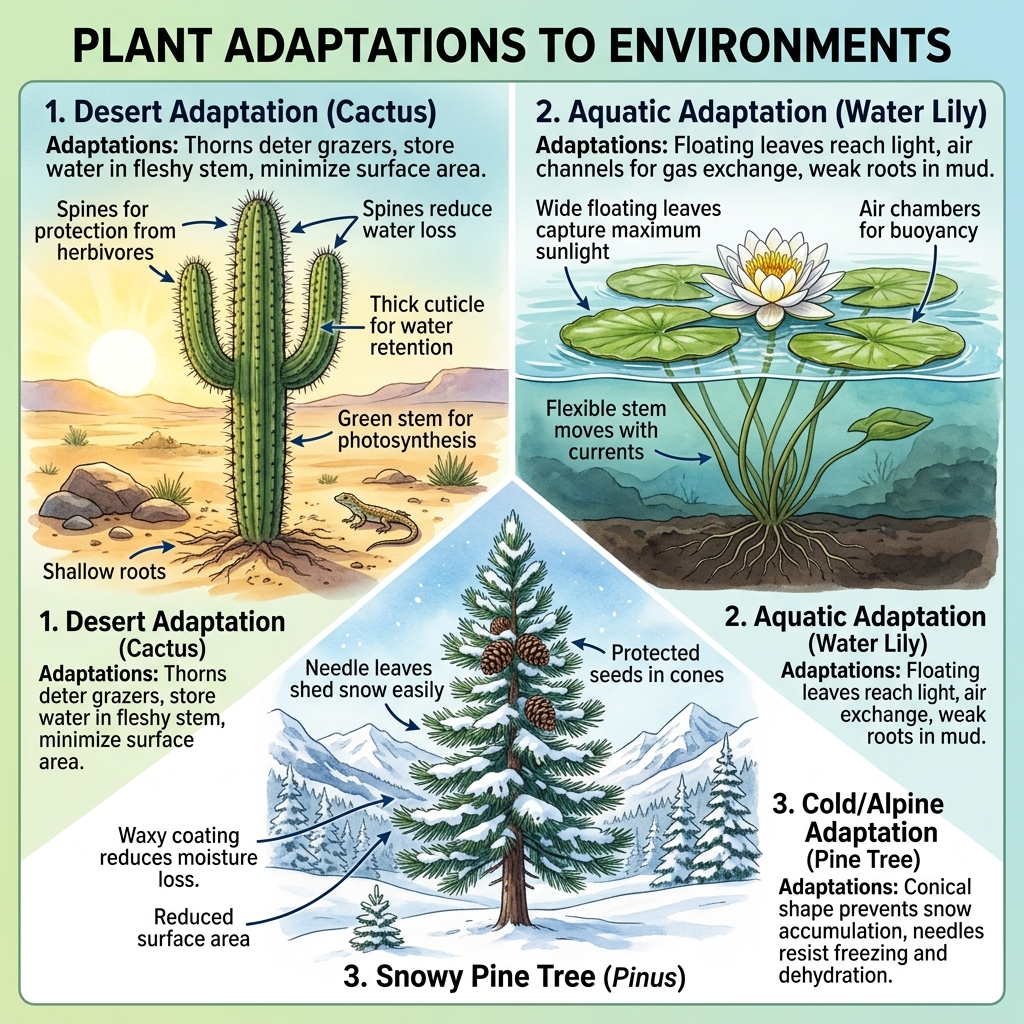
1. Desert Plant Adaptations (Xerophytes)
Plants living in deserts are called xerophytes. They survive in very hot and dry conditions where water is scarce.
Key Features:
- Water Storage: Thick, fleshy stems store water (Succulence).
- Reduced Leaves: Leaves are modified into spines to reduce water loss.
- Waxy Coating: A thick cuticle prevents evaporation.
- Extensive Roots: Deep roots reach underground water; shallow roots catch surface moisture.
Examples: Cactus, Date Palm, Aloe Vera.
2. Aquatic Plant Adaptations (Hydrophytes)
Plants living in water are called hydrophytes. They have features that help them float and stay stable.
Key Features:
- Buoyancy: Stems contain large air spaces (Aerenchyma) to help them float.
- Surface Exposure: Broad leaves float on the surface to capture sunlight.
- Water Repelling: Waxy leaf surfaces prevent water from soaking the plant.
- Flexible Stems: Weak, flexible stems move with water currents.
Examples: Lotus, Water Lily, Hydrilla.
3. Mountain Plant Adaptations (Conifers)
Plants growing in mountain regions are called conifers. They survive in cold climates and heavy snowfall.
Key Features:
- Shedding Snow: Conical shape and sloping branches allow snow to slide off easily.
- Needle Leaves: Needle-shaped leaves reduce water loss and resist freezing.
- Protection: Thick bark protects the inner tissues from extreme cold.
Examples: Pine, Fir, Deodar.
4. Plains Plant Adaptations (Deciduous Plants)
Plants growing in plains experience moderate climates and sufficient water supply.
Key Features:
- Maximized Photosynthesis: Broad leaves help absorb maximum sunlight.
- Drought Resistance: Seasonal shedding of leaves reduces water loss during dry periods.
- Structural Strength: Strong trunks and branches provide support for large canopies.
Examples: Mango, Banyan, Neem.
🌍 Importance of Plant Adaptations
Adaptations are essential for maintaining the balance of nature.
- Survival: Helps plants thrive in otherwise uninhabitable conditions.
- Ecological Balance: Supports various food chains and oxygen production.
- Biodiversity: Allows a wide variety of life to exist across different climates.
🌱 Special Adaptations Summary
| Part | Adaptation Type | Purpose |
|---|---|---|
| Leaves | Spines / Needles | Reduces water loss (Transpiration) |
| Stem | Fleshy / Green | Water storage and Photosynthesis |
| Roots | Deep Taproots | Reaching deep underground water |
| Roots | Floating Roots | Stability and buoyancy in water |
📊 Adaptation Summary Table
| Habitat | Plant Type | Key Adaptation | Example |
|---|---|---|---|
| Desert | Xerophyte | Thick stem, spines | Cactus |
| Water | Hydrophyte | Air spaces, floating leaves | Lotus |
| Mountains | Conifer | Needle leaves, cone shape | Pine |
| Plains | Deciduous | Broad leaves, seasonal shedding | Mango |
🧠 Practice Questions
Short Answer Questions
- Why do desert plants have spines?
Answer: To reduce the surface area for water loss and protect from herbivores. - Why are mountain plants conical?
Answer: To prevent snow accumulation which could break the branches.
Case-Based Question
A plant has needle-shaped leaves, a conical structure, and grows in a cold, snowy region.
- Identify the habitat: Mountain / Alpine
- Name the plant type: Conifer
- Give one example: Pine or Fir
🎯 Conclusion
Adaptation in plants is a testament to nature's engineering. These special features ensure that plants can grow, reproduce, and support life in every corner of the Earth, from the driest deserts to the deepest waters.