
Reproduction in Plants – Types, Methods and Examples
 Hero Image
📌 Introduction
Reproduction is the process by which living organisms produce new individuals of their own kind. In plants, reproduction ensures the continuation of species and helps in maintaining ecological balance. Plants reproduce through asexual and sexual methods, making the topic important for understanding life processes.
📜 Key Concepts
👉 Reproduction in Plants = Process of producing new plants
👉 Two main types:
- Asexual Reproduction 🌿
- Sexual Reproduction 🌸
👉 Importance:
- Maintains species continuity
- Increases population size
- Ensures survival over generations
🌿 Types of Reproduction in Plants
1. Asexual Reproduction 🌱
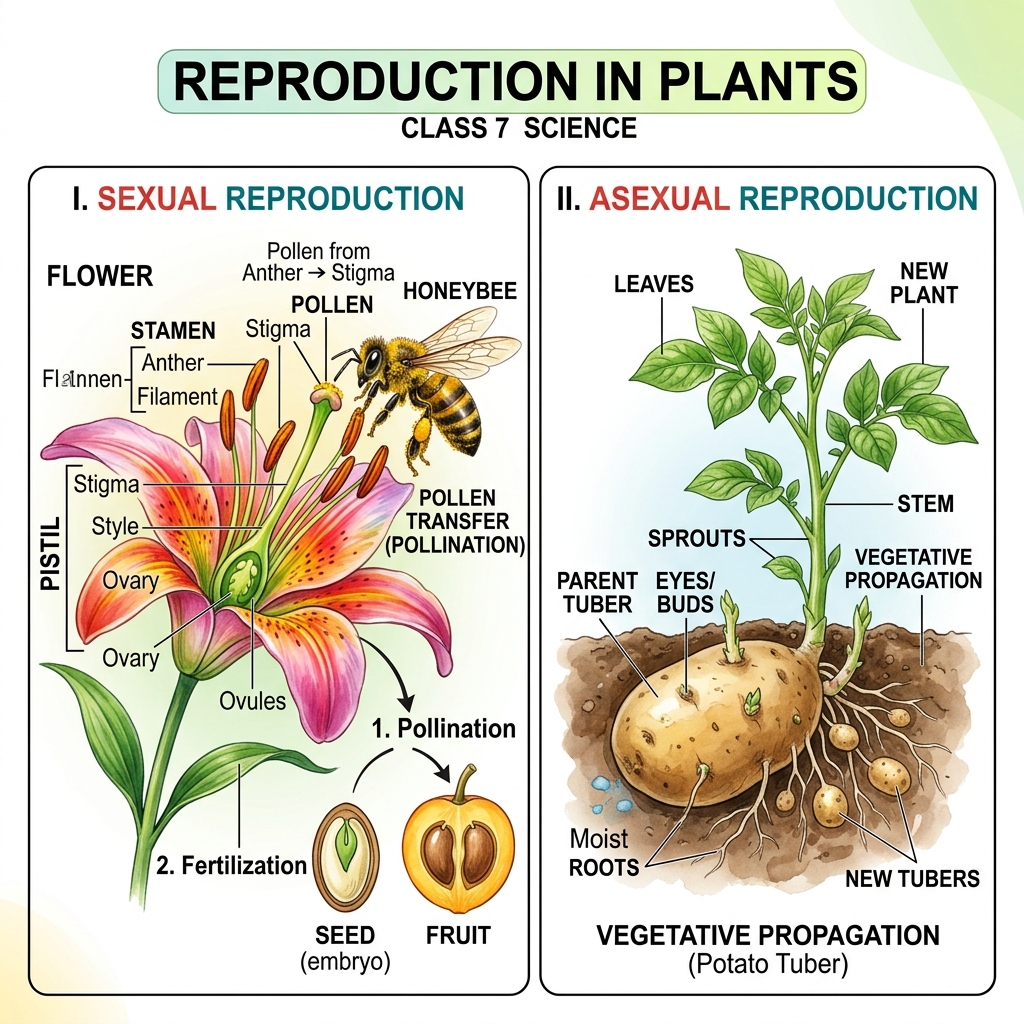
Asexual reproduction involves only one parent and does not require seeds. The new plants are exact copies of the parent plant.
Key Features:
- No fertilization or fusion of gametes.
- Fast process compared to sexual reproduction.
- Produces genetically identical plants.
Methods:
- Vegetative Propagation (stem, root, leaf)
- Budding
- Fragmentation
- Spore Formation
Examples:
- Potato (stem eyes)
- Bryophyllum (leaf buds)
- Sugarcane (stem cuttings)
2. Sexual Reproduction 🌸
Sexual reproduction involves male and female parts of a flower. It requires the fusion of male and female gametes to produce seeds.
Key Steps:
- Pollination 🌼: Transfer of pollen from anther to stigma.
- Fertilization 🌱: Fusion of male and female gametes.
- Seed formation: Development of embryo into a seed.
Parts Involved:
- Stamen: The male reproductive part (Anther and Filament).
- Pistil: The female reproductive part (Stigma, Style, and Ovary).
Examples:
- Mango, Sunflower, Rose, Mustard.
🌼 Pollination Types
Self-Pollination
- Pollen transfer within the same flower or another flower of the same plant.
Cross-Pollination
- Pollen transfer from the anther of one flower to the stigma of another flower on a different plant of the same species.
- Helped by pollinators like wind, insects, and water.
🌱 Seed Formation & Germination
After fertilization occurs:
- Ovule develops into the Seed.
- Ovary grows into the Fruit.
Germination Conditions: To grow into a new plant, a seed requires:
- Water 💧
- Air (Oxygen) 🌬️
- Suitable temperature 🌡️
📊 Vegetative Propagation Summary
| Plant Part | Method of Propagation | Examples |
|---|---|---|
| Stem | Eyes, Cuttings, Tubers | Potato, Rose, Sugarcane, Ginger |
| Leaf | Marginal Buds | Bryophyllum, Begonia |
| Root | Adventitious Buds | Sweet Potato, Dahlia |
| Spores | Spore Formation | Ferns, Mosses, Bread Mould |
⚠️ Advantages & Disadvantages
Advantages of Asexual Reproduction
✔ Fast growth and multiplication. ✔ No dependency on pollinators. ✔ Identical plants preserve parental traits.
Disadvantages
❌ No genetic variation. ❌ Less adaptability to changing environments.
📘 Practice Questions
🔹 Section A: MCQs
Q1. Asexual reproduction involves:
- a) Two parents
- b) One parent ✅
- c) Seeds only
- d) Flowers only
Q2. Which plant reproduces through its leaves?
- a) Potato
- b) Rose
- c) Bryophyllum ✅
- d) Mango
Q3. The male reproductive part of a flower is:
- a) Stamen ✅
- b) Pistil
- c) Ovary
- d) Stigma
🔹 Section B: Case-Based Questions
Case: A student observes a plant growing from a leaf margin without any seeds being planted.
- Identify the type of reproduction: Asexual reproduction.
- Name the specific method: Vegetative propagation (via leaves).
- Give an example of such a plant: Bryophyllum.
🎯 Conclusion
Reproduction in plants is essential for the survival and growth of plant species. Understanding both asexual and sexual reproduction helps students learn how plants grow, reproduce, and adapt in nature.