
The Early Medieval Period: Regional Kingdoms and Culture
The Early Medieval Period in India serves as a transition between the classical age of the Guptas and the establishment of the Delhi Sultanate. This era is defined by the rise of powerful regional kingdoms, magnificent temple architecture, and significant cultural developments.
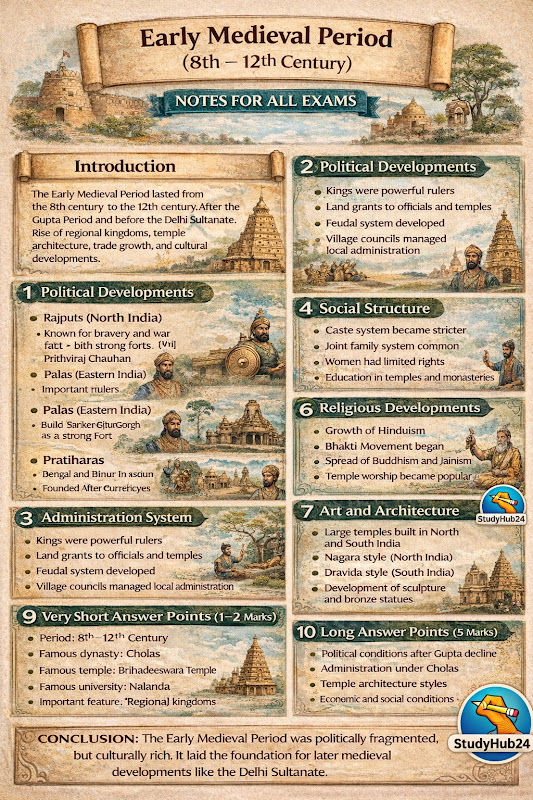 Early Medieval Temple Architecture
📌 Political Landscape
After the decline of central authority in North India, several regional dynasties rose to prominence:
1. The Rajputs (North & West India)
- Known for their bravery and legendary warfare.
- Built massive, nearly impregnable forts like Chittorgarh.
- Famous Rulers: Prithviraj Chauhan.
2. The Palas (Eastern India)
- Ruled over Bengal and Bihar.
- Great patrons of Buddhism; they supported centers like Nalanda and Vikramshila University.
3. The Cholas (South India)
- Developed a highly efficient administrative system.
- Built the world-famous Brihadeeswara Temple (Tanjore).
- Possessed a strong navy and traded extensively with Southeast Asia.
4. The Rashtrakutas (Deccan)
- Known for their patronage of art, particularly the monolithic Kailasa Temple at Ellora.
📜 Administration and Society
- Feudalism: A decentralized system of governance emerged where land was granted to officials and temples in exchange for service.
- Village Administration: Especially under the Cholas, village councils had significant autonomy.
- Social Structure: The caste system became more rigid, and education was primarily centered around temples and mathas.
🌾 Economy and Trade
- Agriculture: Remained the backbone of the economy, with land revenue being the primary source of state income.
- Foreign Trade: India expanded its maritime trade with Arab countries and Southeast Asia, leading to the growth of prosperous port cities.
🕉️ Religion and Art
- Religious Shifts: Hinduism saw a massive revival, and the Bhakti Movement began to take shape.
- Architecture: This period saw the perfection of two major temple styles:
- Nagara Style in North India.
- Dravida Style in South India.
🇮🇳 प्रारंभिक मध्यकालीन भारत (8वीं - 12वीं शताब्दी)
परिचय
प्रारंभिक मध्यकाल 8वीं शताब्दी से 12वीं शताब्दी तक का समय था। यह काल क्षेत्रीय राज्यों के उदय, भव्य मंदिरों के निर्माण और व्यापारिक उन्नति के लिए जाना जाता है।
प्रमुख राजवंश:
- राजपूत: अपनी वीरता और किलों के लिए प्रसिद्ध (जैसे चित्तौड़गढ़)।
- चोल: शक्तिशाली नौसेना और दक्षिण-पूर्व एशिया के साथ व्यापार के लिए जाने जाते हैं।
- पाल: पूर्वी भारत में शासन और बौद्ध धर्म के संरक्षक।
प्रशासन और संस्कृति:
- सामंतवाद: भूमि दान प्रथा और विकेंद्रीकृत प्रशासन का उदय।
- स्थापत्य: उत्तर भारत में 'नागर शैली' और दक्षिण भारत में 'द्रविड़ शैली' के मंदिरों का विकास।
निष्कर्ष
प्रारंभिक मध्यकालीन भारत राजनीतिक रूप से विभाजित होने के बावजूद सांस्कृतिक और कलात्मक रूप से अत्यंत समृद्ध था, जिसने आने वाले समय के लिए एक मजबूत आधार तैयार किया।