
Acids, Bases, and Salts: A Chemistry Guide
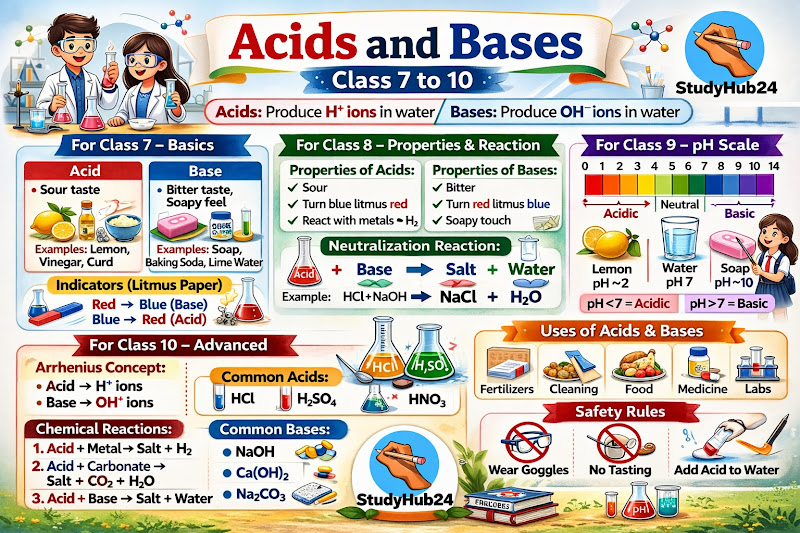 Acids and Bases Overview
Acids and bases are among the most common chemical substances we encounter in our daily lives. From the citrus fruits we eat to the soap we use for washing, chemistry is at work everywhere.
🍋 What is an Acid?
The word "acid" comes from the Latin word acere, which means sour. Acids are substances that release hydrogen ions (H⁺) when dissolved in water.
- Taste: Sour.
- Indicators: Turns blue litmus paper red.
- Examples: Lemon juice (citric acid), Vinegar (acetic acid), and Curd (lactic acid).
Types of Acids
- Natural (Organic) Acids: Found in plants and animals (e.g., Tartaric acid in tamarind).
- Mineral (Inorganic) Acids: Prepared from minerals in the earth. These are often strong and corrosive (e.g., Hydrochloric acid - HCl, Sulphuric acid - H₂SO₄).
🧼 What is a Base?
Bases are substances that release hydroxide ions (OH⁻) when dissolved in water. Bases that are soluble in water are called alkalis.
- Taste: Bitter.
- Touch: Feels soapy or slippery.
- Indicators: Turns red litmus paper blue.
- Examples: Baking soda, Soap solution, and Lime water.
📊 The pH Scale
The pH scale is used to measure how acidic or basic a substance is. It ranges from 0 to 14.
- pH < 7: Acidic (Lower the pH, stronger the acid).
- pH = 7: Neutral (Pure water).
- pH > 7: Basic/Alkaline (Higher the pH, stronger the base).
🔄 Neutralization Reaction
When an acid and a base react together, they cancel out each other's properties to form Salt and Water. This is called a neutralization reaction.
Equation:
Acid + Base → Salt + Water + Heat
Example:
HCl (Acid) + NaOH (Base) → NaCl (Salt) + H₂O (Water)
Applications in Daily Life:
- Indigestion: When our stomach produces too much acid, we take an antacid (a mild base like Milk of Magnesia) to neutralize it.
- Ant Sting: An ant's sting contains formic acid. Rubbing baking soda (a base) on the area neutralizes the acid and reduces pain.
- Soil Treatment: If soil is too acidic, farmers treat it with quicklime (calcium oxide).
🧪 Indicators
Since we cannot taste every substance to check if it's an acid or base, we use indicators.
| Indicator | In Acid | In Base |
|---|---|---|
| Litmus Paper | Turns Red | Turns Blue |
| Turmeric | Remains Yellow | Turns Reddish-Brown |
| China Rose | Turns Dark Pink | Turns Green |
| Phenolphthalein | Colorless | Turns Pink |
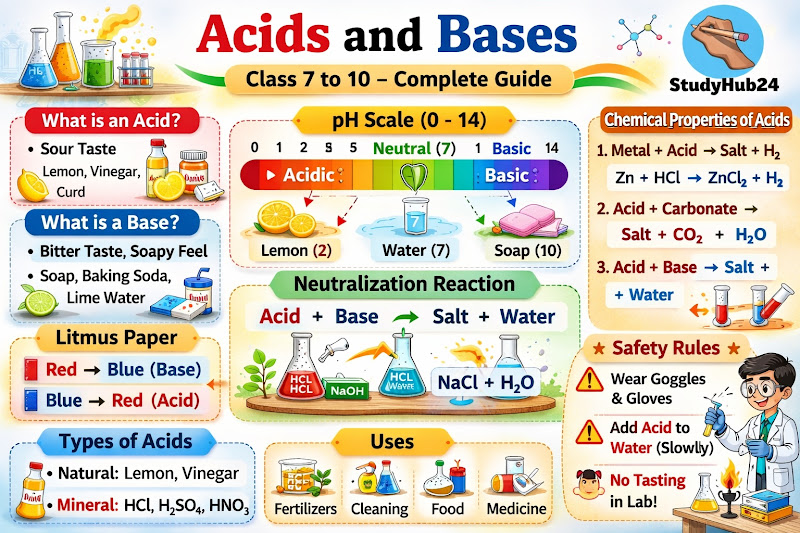 Chemical Indicators
⚠️ Laboratory Safety
- Never Taste: Never taste or touch chemicals unless instructed.
- Dilution: Always add acid to water slowly while stirring. Never add water to concentrated acid, as it can cause a dangerous explosion of heat.
- Protection: Use gloves and safety goggles when handling strong mineral acids.