
Light
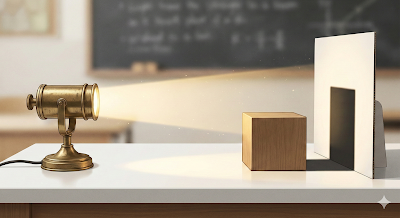 Properties of Light
📌 What is Light?
At its simplest, light is a form of energy that travels in waves. It is the only form of energy we can actually see! Light travels in straight lines and allows us to perceive the world around us.
🔹 Luminous and Non-Luminous Objects
- Luminous objects: Objects that emit their own light (e.g., the Sun, stars, a glowing bulb).
- Non-luminous objects: Objects that do not give out their own light but become visible when they reflect light from a luminous source (e.g., the Moon, a table, a book).
🚀 Fun Fact: The Speed Demon
Light is the fastest thing in the universe. It travels at approximately 300,000 kilometers per second (3 × 10⁸ m/s).
- It takes light only about 8 minutes to travel 150 million kilometers from the Sun to Earth.
- If you could travel at the speed of light, you could go around the Earth 7.5 times in just one second!
🌈 The Properties of Light
To understand how light works, we look at how it interacts with different materials. The primary properties are:
1. Rectilinear Propagation (Straight Line Travel)
Light always travels in straight lines called rays. This is why shadows are formed! When an opaque object blocks these straight rays, it creates a dark area behind it.
2. Reflection (The Bounce)
When light falls on a polished or shiny surface and bounces back, it is called reflection.
The Laws of Reflection:
- The incident ray, the reflected ray, and the normal at the point of incidence all lie in the same plane.
- The angle of incidence (∠i) is always equal to the angle of reflection (∠r).
Types of Reflection:
- Regular reflection: Occurs from smooth surfaces like mirrors, creating a clear image.
- Diffused reflection: Occurs from rough surfaces, scattering light in many directions.
Spherical Mirrors:
- Concave Mirror: Curves inward. Used in shaving mirrors, dentists' tools, and car headlights.
- Convex Mirror: Curves outward. Used as rear-view mirrors in vehicles because they provide a wider field of view.
3. Refraction (The Bend)
Have you ever noticed a straw looking "broken" in a glass of water? That’s refraction. When light moves from one transparent medium to another (like from air to water), it changes speed and bends.
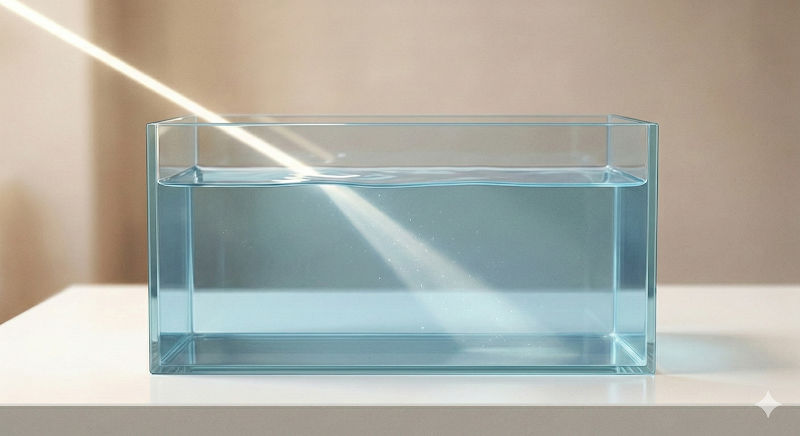 Refraction Example
4. Dispersion (Splitting of Colors)
"White" light isn't actually white—it’s a mixture of seven colors. When white light passes through a glass prism, it splits into its component colors: Red, Orange, Yellow, Green, Blue, Indigo, and Violet (VIBGYOR). This phenomenon is called dispersion.
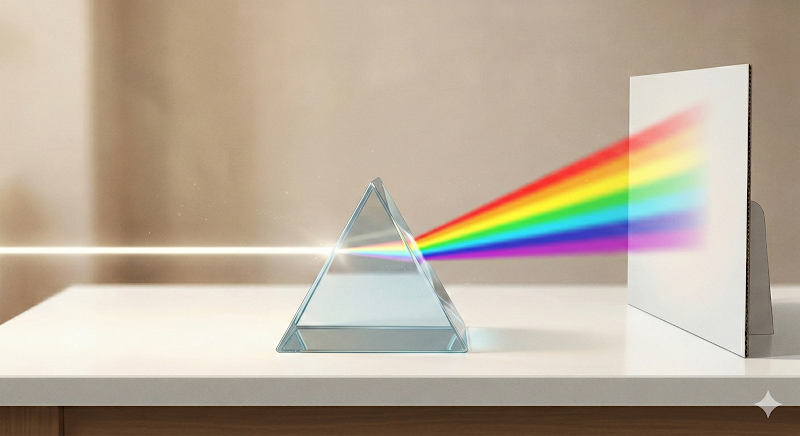 Dispersion through a Prism
🧱 Materials vs. Light
Not all objects treat light the same way. We categorize them based on how much light they allow to pass through:
| Material Type | Description | Examples |
|---|---|---|
| Transparent | Allows almost all light to pass through. Objects can be seen clearly. | Clear Glass, Water, Air |
| Translucent | Allows some light through, but scatters it. Objects look blurry. | Butter Paper, Frosted Glass |
| Opaque | Allows no light to pass through. They cast dark shadows. | Wood, Metal, Stone, Cardboard |
🔬 "Try This!" – Home Experiments
- The Bending Pencil: Place a pencil in a half-full glass of water. Look at it from the side to see refraction in action.
- CD Rainbows: Hold the back of a CD under a bright light. The tiny grooves act like a prism to show dispersion.
- Mirror Writing: Try writing your name so it looks "normal" when held up to a mirror. This demonstrates lateral inversion.
🧠 Quick Quiz
Q1: What is a natural source of light?
👉 The Sun, stars, and fireflies.
Q2: Can light travel through a vacuum (empty space)?
👉 Yes! Unlike sound, light does not need a medium. This is how sunlight reaches Earth through the vacuum of space.
Q3: Why do we see a red apple as red?
👉 Because the apple reflects red light and absorbs all other colors of the visible spectrum.
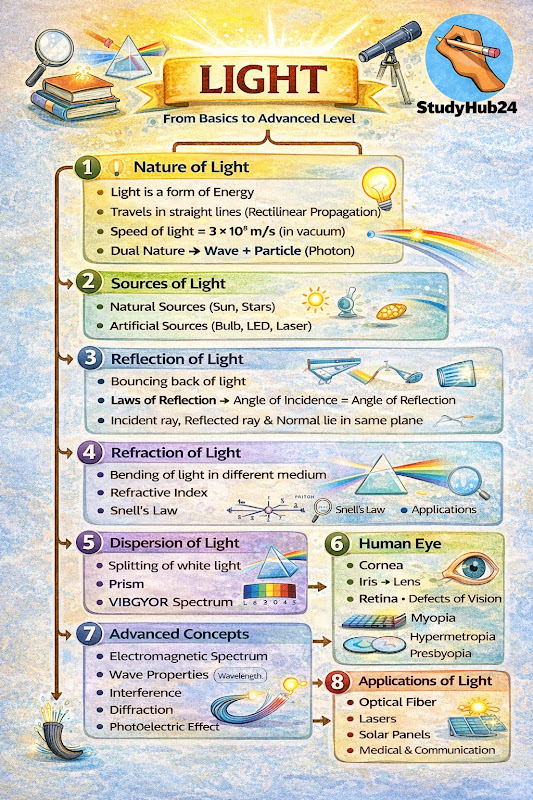 Light Concept