
Electric Current and Its Effects
 Introduction to Electricity
📌 Introduction
Electricity is one of the most vital forms of energy in the modern world. It powers our homes, schools, industries, and communication systems. From lighting a bulb to operating complex computers, electricity is the backbone of daily life.
Electricity is the result of the movement of tiny charged particles called electrons. When these electrons flow through a conductor (like a metal wire), an electric current is produced.
💡 What is Electric Current?
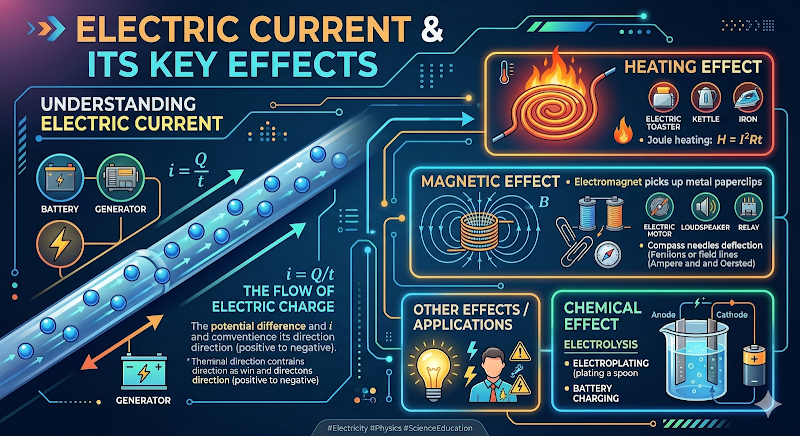
Electric current is defined as the flow of electric charges through a conductor. These charges move from one point to another when a voltage source (like a battery or cell) is connected to a circuit.
Formula and Units
Electric current is calculated using the formula: I = Q / t
Where:
- I = Electric Current
- Q = Electric Charge (measured in Coulombs)
- t = Time (measured in seconds)
👉 SI Unit: The SI unit of electric current is the Ampere (A). It is measured using a device called an ammeter, which is always connected in series in a circuit.
🔄 Electric Circuits
An electric circuit is a complete, closed path through which electric current flows.
Main Components:
- Electric Cell or Battery: The source of electrical energy.
- Connecting Wires: Conductors (usually copper) that allow current to travel.
- Switch: A device used to open or close the circuit.
- Electrical Device (Load): Appliances like bulbs or fans that use energy.
Types of Circuits:
- Closed Circuit: The switch is ON, the path is complete, and current flows.
- Open Circuit: The switch is OFF or the wire is broken; current cannot flow.
🧱 Conductors and Insulators
| Type | Description | Examples |
|---|---|---|
| Conductors | Materials that allow electric current to pass through them easily. | Copper, Aluminium, Iron, Silver, Tap Water |
| Insulators | Materials that do not allow electric current to pass through. | Rubber, Plastic, Glass, Dry Wood |
⚡ Effects of Electric Current
When current flows through a conductor, it produces three primary effects:
1. Heating Effect 🔥
When electric current passes through a wire, the wire gets hot. This is due to the resistance the wire offers to the flow of current.
- Applications: Electric irons, heaters, geysers, and toasters.
- Safety Device: An Electric Fuse uses this effect. It contains a wire with a low melting point that melts and breaks the circuit if the current becomes too high.
2. Magnetic Effect 🧲
Electric current flowing through a wire creates a magnetic field around it. This was discovered by Hans Christian Ørsted.
- Electromagnet: A temporary magnet made by winding a wire around an iron core. It only acts as a magnet when current is flowing.
- Applications: Electric bells, cranes for lifting scrap metal, and electric motors.
3. Chemical Effect ⚗️
When current passes through a chemical solution (electrolyte), it causes chemical reactions.
- Electroplating: The process of depositing a thin layer of one metal over another (e.g., gold plating on jewelry or chromium on car parts).
🛡️ Electrical Safety
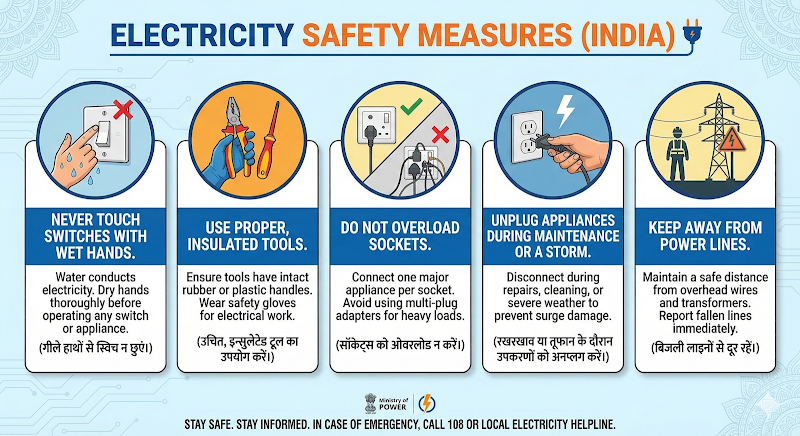
Electricity is useful but can be fatal if mishandled. Always follow these rules:
- Never touch electrical appliances with wet hands.
- Use insulated tools and wear rubber-soled shoes.
- Do not overload a single electrical socket.
- Immediately replace damaged or frayed wires.
- Always use a fuse or MCB (Miniature Circuit Breaker) in your home circuits.
🔬 Student Activity: Build a Simple Circuit
What You Need: A 1.5V cell, a small LED bulb, a switch, and three pieces of connecting wire.
Steps:
- Connect one end of the cell to the switch.
- Connect the other end of the switch to the bulb.
- Complete the loop by connecting the bulb back to the other end of the cell.
- Observe: Flip the switch. When the circuit is "Closed," the bulb glows. When it is "Open," the bulb turns off.
🧠 Knowledge Check
Q1: What is the thin wire inside an electric bulb called?
👉 Filament (usually made of Tungsten because of its high melting point).
Q2: Why are insulators used to cover electrical wires?
👉 To prevent electric shocks by blocking the flow of current from the wire to our hands.
Q3: Which device is used to measure electric current?
👉 Ammeter.
Q4: What happens when a fuse wire melts?
👉 It breaks the circuit, stopping the flow of electricity and preventing potential fires or damage to appliances.
 Electrical Safety