
The Solar System and Earth's Layers
 The Solar System
☀️ Overview of the Solar System
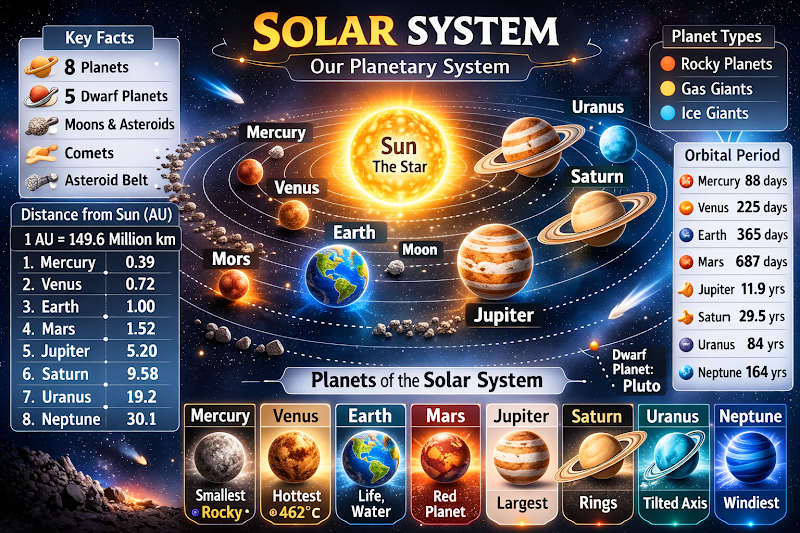
Our solar system is a vast collection of celestial bodies bound together by the Sun's gravity. It consists of:
- The Sun (a central star)
- Eight Planets and their moons
- Dwarf Planets (like Pluto, which was reclassified in 2006)
- Asteroids, comets, and meteoroids
🪐 The Eight Planets
The planets are divided into two main groups based on their composition and distance from the Sun:
1. Inner Planets (Terrestrial)
These are rocky planets located closest to the Sun:
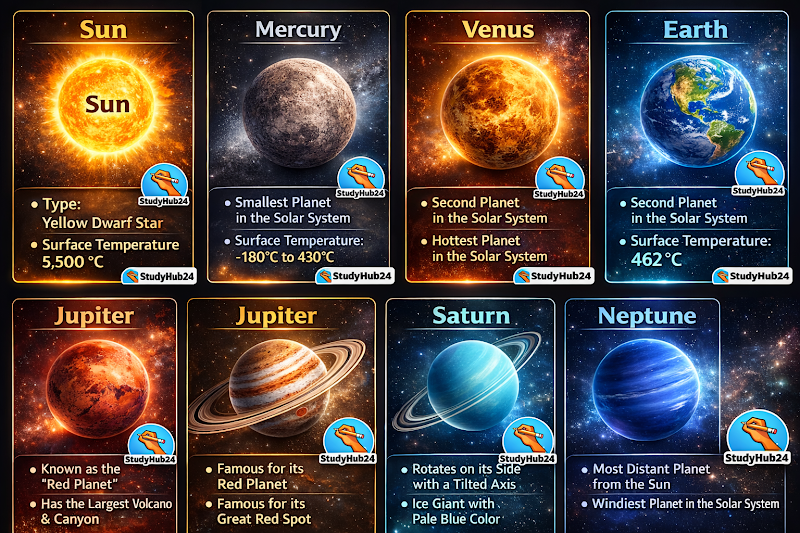
- Mercury: The smallest and closest planet to the Sun.
- Venus: The hottest planet due to its thick atmosphere.
- Earth: Our home, the only planet known to support life.
- Mars: Known as the "Red Planet" due to iron oxide on its surface.
2. Outer Planets (Gas Giants)
These are large planets primarily made of gases and liquids:
- Jupiter: The largest planet in the solar system.
- Saturn: Famous for its extensive ring system.
- Uranus: An "ice giant" with a unique sideways rotation.
- Neptune: The farthest planet from the Sun, known for its deep blue color.
 Planetary Comparison
🌎 Layers of the Earth
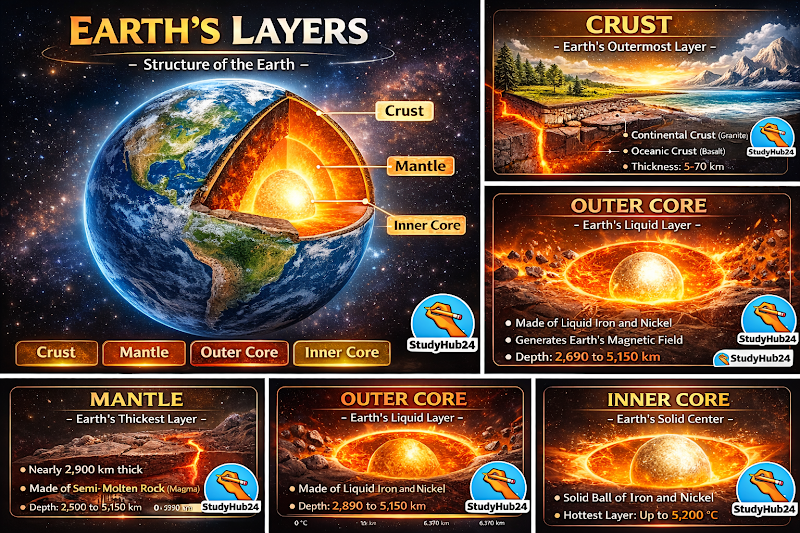
Earth is not a solid rock all the way through. It is composed of four distinct layers with different properties:
 Earth's Internal Structure
1. The Crust
The outermost, thinnest layer where we live. It is made of solid rock and minerals. There are two types: continental crust (land) and oceanic crust (under the oceans).
2. The Mantle
The thickest layer, located beneath the crust. It is made of semi-solid, hot rock that flows very slowly, driving the movement of tectonic plates.
3. The Outer Core
A liquid layer made primarily of molten iron and nickel. Its movement creates the Earth's magnetic field.
4. The Inner Core
A solid sphere at the very center of the Earth. Despite the extreme heat, it remains solid due to the immense pressure from the layers above.
👉 Related Topic: Learn about Photosynthesis and Ecosystems