
Medieval History of India: A Complete Overview
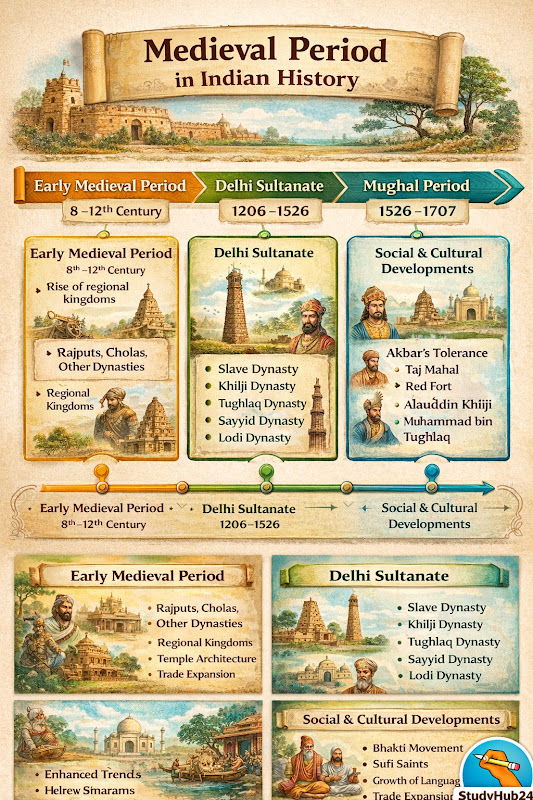 Medieval Indian Architecture
📌 Introduction
The Medieval Period in Indian history lies between the Ancient and Modern eras. It covers roughly one thousand years, from the 8th century to the 18th century. This era is characterized by significant political shifts, the rise of powerful empires, and a unique synthesis of cultures.
The period is generally divided into two parts:
- Early Medieval Period (8th – 12th Century)
- Later Medieval Period (13th – 18th Century)
1. Early Medieval Period (8th–12th Century)
During this time, several regional kingdoms emerged across the Indian subcontinent.
Major Dynasties:
- The Rajputs (North India): Known for their chivalry and the construction of magnificent forts and palaces.
- The Cholas (South India): Famous for their naval supremacy, efficient village administration, and temple architecture (e.g., the Brihadeeswara Temple).
- The Palas and Pratiharas: Major powers that dominated Eastern and Northern India respectively.
2. The Delhi Sultanate (1206–1526)
Following Turkish invasions, the Delhi Sultanate was established, marking the beginning of the Later Medieval Period.
The Five Dynasties:
- Mamluk (Slave) Dynasty
- Khilji Dynasty
- Tughlaq Dynasty
- Sayyid Dynasty
- Lodi Dynasty
Key Contributions:
- Introduction of Indo-Islamic architectural styles (e.g., the Qutub Minar).
- Market regulation and administrative reforms under Alauddin Khilji.
- Expansion of the empire into the Deccan region.
3. The Mughal Empire (1526–1707)
Founded by Babur after the First Battle of Panipat, the Mughal Empire brought much of India under a single central administration.
Great Mughal Emperors:
- Akbar: Known for his policy of religious tolerance (Sulh-i-Kul) and administrative efficiency (Mansabdari system).
- Shah Jahan: The "Engineer King" who built the Taj Mahal and the Red Fort.
- Aurangzeb: Under whom the empire reached its greatest territorial extent.
🎨 Socio-Cultural Developments
The Medieval period was a time of immense cultural richness:
- Religious Movements: The spread of the Bhakti and Sufi movements emphasized devotion and communal harmony.
- Language: Growth of regional languages such as Hindi, Bengali, Marathi, Tamil, and Urdu.
- Trade: India became a global hub for textiles, spices, and handicrafts, trading extensively with Europe and the Middle East.
🇮🇳 मध्यकालीन भारत का इतिहास (8वीं - 18वीं शताब्दी)
परिचय
भारतीय इतिहास में मध्यकालीन काल प्राचीन और आधुनिक काल के बीच का सेतु है। यह काल 8वीं शताब्दी से शुरू होकर 18वीं शताब्दी तक चला।
प्रमुख चरण:
- प्रारंभिक मध्यकाल (8वीं - 12वीं शताब्दी)
- उत्तर मध्यकाल (13वीं - 18वीं शताब्दी)
प्रमुख विशेषताएं:
- दिल्ली सल्तनत: कुतुबुद्दीन ऐबक द्वारा स्थापित, जिसमें गुलाम, खिलजी, तुगलक, सैयद और लोदी वंशों ने शासन किया।
- मुगल साम्राज्य: बाबर द्वारा 1526 में स्थापित। अकबर, शाहजहाँ और औरंगजेब जैसे शासकों ने इसे वैश्विक शक्ति बनाया।
- कला और संस्कृति: ताजमहल, कुतुब मीनार और लाल किला जैसे स्मारकों का निर्माण हुआ। भक्ति और सूफी आंदोलनों ने समाज में प्रेम और भाईचारे का संदेश दिया।
निष्कर्ष
मध्यकालीन काल ने भारत की सांस्कृतिक विविधता, भाषा, कला और प्रशासनिक प्रणाली को गहराई से प्रभावित किया, जिसने आधुनिक भारत की नींव रखने में महत्वपूर्ण भूमिका निभाई।